


Equine-Assisted Services - Why is it important to understand this area?

When we talk about Equine Assisted Services , it's still common to encounter questions.
Some people believe we are talking about a single methodology. Others associate the entire field only with therapies. There are those who use different nomenclatures to refer to similar practices, and often the public itself has difficulty understanding which services exist and which one meets their needs.
But the reality is much broader.
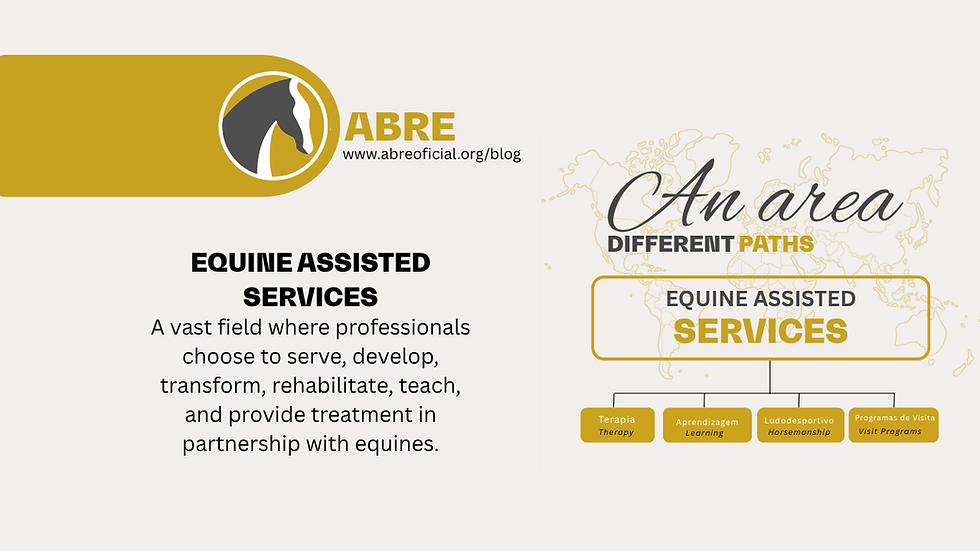
Equine-Assisted Services constitute a large area of activity, formed by different segments, methodologies and approaches that share the same purpose: to promote human development in partnership with intervention horses.
Understanding this organization is important not only for professionals in the field, but also for the assisted people, their families, institutions, public administrators, and researchers. After all, the greater the clarity regarding the different segments, the safer, more ethical, and more assertive the decisions related to the practice, training, and development of the field will be.
Far beyond methods, an area of knowledge.
Regardless of the methodology used, professionals working in Equine-Assisted Services share a common purpose:
To promote health.
To promote learning.
To stimulate human development.
Expand social participation.
To build meaningful experiences.
Always working in partnership with intervention horses and with an ethical commitment to their well-being.
Each professional follows a different path.
Each person being assisted has specific needs.
Each intervention has its own objectives.
And this does not represent a fragmentation of the area.
It represents your wealth and your maturity.
Just as healthcare encompasses different specialties and education includes diverse teaching methodologies, Equine-Assisted Services are also composed of different areas of activity.
Different segments, distinct objectives.
Although they share the same purpose, the segments of Equine Assisted Services have distinct objectives.
Equine-Assisted Therapies
In this segment, the purpose of the work is healthcare treatment .
The interventions are conducted by qualified healthcare professionals, each acting within their legal and technical competence, with objectives related to prevention, habilitation, rehabilitation, or health promotion.
There are different therapeutic methodologies and approaches.
What characterizes this segment is not the methodology used, but rather the profession of the person who will serve the public and the therapeutic objective.
Equine-Assisted Learning
Here, the focus is on learning and skills development .
The programs can serve children, adolescents, adults, teams, schools, and companies, promoting the development of cognitive, socio-emotional, educational, or personal development skills.
The strategies are diverse, with or without horseback riding, always defined by the learning objectives.
Adapted sports activities and hosermanship
This segment utilizes equestrian disciplines and horsemanship as tools to promote human development, social inclusion, leisure, and quality of life.
More than just teaching a sport, these activities promote autonomy, social participation, improved self-esteem, and access to the equestrian world in a way that is tailored to each client's needs.
Visit Programs
These are programs aimed at promoting well-being through interaction between people and equine intervention in environments such as hospitals, long-term care facilities, shelters, and other community spaces.
Because they involve different displacements and contexts, they require careful planning and trained professionals, especially in equine behavior, handling, and welfare.
Why is this distinction so important?
When we understand the different segments of Equine Assisted Services, everyone benefits.
Families are able to identify which service meets their needs.
Professionals operate with greater technical, ethical, and legal certainty, respecting the ethical boundaries of their profession.
Institutions are structuring their programs and interventions with greater clarity.
Public managers are finding more consistent definitions for the development of public policies.
Health insurance providers and funders are able to better understand the nature of each service.
And science is also advancing.
Without clear definitions, it becomes difficult to compare studies, produce robust evidence, and develop research capable of strengthening the field.
Any field that wants to grow needs, first and foremost, to build a common language.
What unites us is greater than what differentiates us.
Equine-Assisted Services are comprised of different segments, different methodologies, and different approaches.
This diversity does not represent division.
It represents the area's ability to respond to the different needs of society.
More important than discussing which methodology is best is understanding which intervention is most appropriate for each person, in each context, and for each objective.
It is this vision that strengthens an area.
At ABRE, we believe that recognizing this diversity is an essential step in promoting ethical, qualified, evidence-based practice committed to the development of people and the well-being of intervention horses.
Because strengthening Equine-Assisted Services means strengthening everyone who is part of this broader field.
One area. Different paths. One common purpose.


Comments